Older People’s Medicines Care at Home in Dorset
Medication management for older people in Dorset can make daily routines at home easier to follow, particularly when prescriptions change. Home care can support an agreed medicines routine, while questions about whether treatment remains suitable should be discussed with a healthcare professional. NHS Dorset’s medicines team works with GPs, pharmacists, nurses and other professionals to support better medicines use.
It’s understandable to feel concerned if an older relative takes several medicines, struggles with their routine or feels unsure after a prescription change. Good support respects their choices and independence. A clear approach to medication management for older people in Dorset can help families understand how practical assistance fits alongside professional advice.
This article explains how home care can support medicines routines, what to consider when discussing a medicines review and how to respond to prescription changes. It also covers NHS and council support in Dorset, pharmacy compliance aids and how medication management for older people in Dorset can fit into a person’s wider care at home.
Key Takeaways
- Home care can support an older person with their medicines routine while preserving independence and familiar routines at home.
- A medicines review can help identify when treatment may need reconsideration; bring clear information about current medicines and any concerns.
- After a prescription changes, keep the instructions together and make sure everyone supporting the person understands the updated routine.
- Blister packs and other compliance aids may help some people, but the right option depends on individual needs and medicines.
- When more support is needed at home, explore care tailored to the person, including help with day-to-day routines and medicines.
Home care for older adults in Dorset
For an older person in Dorset, home care can support medicines routines while they remain in familiar surroundings. Help can be tailored to their daily habits, such as a carer prompting them during an agreed visit or helping keep medicine information together. The person remains central to decisions about their care.
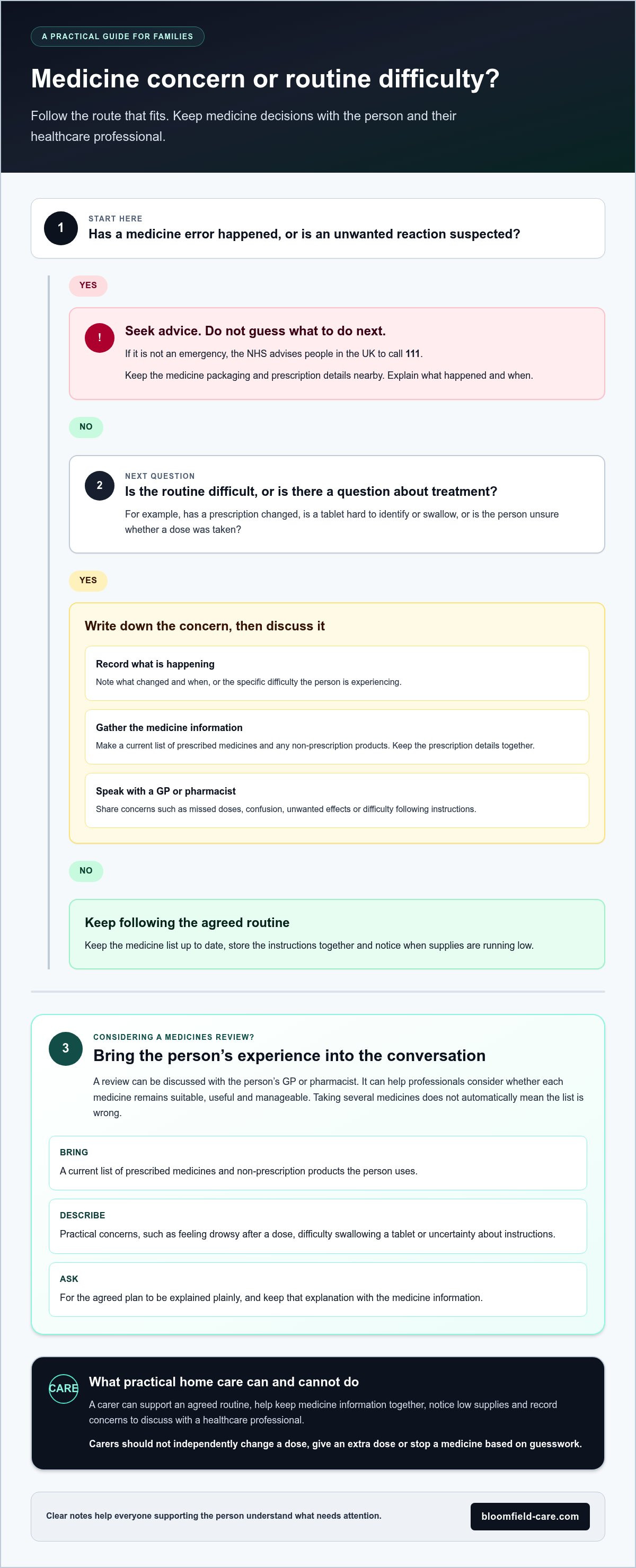
A useful first step is to write down what is causing concern. A prescription may have changed, a tablet may be difficult to identify, or the person may be unsure whether they have taken a dose. A clear record helps them explain the issue to their GP or pharmacist and keeps conversations with family and carers focused.
If someone has made a medication error or suspects an adverse reaction, seek urgent advice rather than guessing what to do next. For a situation that is not an emergency, the NHS advises people in the UK to call 111. Keep the medicine packaging and prescription details nearby, and explain what happened and when.
Home support can help with practical parts of a routine without replacing advice from a prescriber or pharmacist. A carer can help the person follow the instructions they have been given, notice when supplies are running low or record a concern to discuss with a healthcare professional. Carers should not independently change a dose or stop a medicine.
- Keep a current list: record medicine names and the instructions shown on the packaging or prescription.
- Note changes: write down what has changed and when, so the GP or pharmacist has a clear account.
- Share concerns: tell the relevant healthcare professional about missed doses, confusion or possible unwanted effects.
In Dorset, NHS Dorset’s medicines team works with GPs, pharmacists, nurses and other healthcare professionals to support better medicines use. It does not provide pharmacy services. This coordinated approach can help families understand who to speak to about a medicine or where to raise a concern.
Dorset County Hospital’s SDEC frailty assessment may include a review of the medicines a patient takes. Keep medicine details accessible during healthcare appointments. At home, a familiar routine, an up-to-date list and clear communication help everyone supporting the older person understand what needs attention.
Overprescribing and medicines review
A medicines review looks at whether each medicine remains suitable, useful and manageable for the person taking it. In a Dorset care home, staff should be able to explain how medicines are stored, administered and recorded, including how they document a missed dose or refusal.
Medication management costs
The cost of paid medication support depends on the care needed and is provided after a quote request. Factors include how often support is needed, the length of visits and the level of help required with daily routines. A medicines review is a separate clinical discussion, so clarify whether you mean professional review or practical support at home.
Missed doses and taking difficulties
If someone misses a dose, carers should record what happened and follow the instructions already provided for that medicine. They should not give an extra dose, change the timing or stop treatment based on guesswork. If swallowing, opening packaging or remembering doses is difficult, note the specific problem and share it with the person’s GP or pharmacist.
What a review can examine
Concerns about overprescribing can arise when someone takes several medicines, experiences unwanted effects or no longer understands why a treatment is on their list. A review brings their current medicines and health needs into one conversation. The aim is to help professionals consider whether treatment remains appropriate, not to assume that a long list is automatically wrong.
Before a discussion, gather a current list of prescribed medicines and any non-prescription products the person uses. Note practical concerns, such as feeling drowsy after a dose, difficulty swallowing a tablet or uncertainty about instructions. These examples help the person describe everyday experience, not just what appears on a prescription.
Information professionals should record
For dual therapy, clinicians should record the indication, dose and duration in the patient’s records. This gives professionals a clear account of why the medicines are being used and how treatment is intended to proceed. If the person or family is unsure about the plan, ask the prescriber to explain it plainly and keep the explanation with the medicine information.
Where a review can take place
Dorset County Hospital’s SDEC frailty assessment may include a review of the medicines a patient takes. A medicines review can also be discussed with the person’s GP or pharmacist. Bring current prescription details and describe any recent changes, difficulties or concerns. A clear record helps professionals understand the person’s experience and consider next steps together.
Patients attending Dorset County Hospital’s SDEC assessment are asked to bring a copy of their prescription and their medication so they can take it as usual. Having these to hand can support a clear discussion of what is prescribed, how it is taken and any difficulties the person has noticed.
Keep the conversation focused on the person’s experience, including concerns about effects or instructions they do not understand. If anything remains unclear, ask the relevant professional to explain the agreed plan and how to follow it.
Prescription changes
A new prescription or changed instruction can make a familiar routine confusing. Keep the written directions together and clarify anything unclear before the next dose.
Blister packs and compliance aids
Blister packs and multi-compartment compliance aids organise medicines into compartments for different times. A pharmacist can discuss whether an aid suits the person’s medicines and daily routine. Difficulty handling packaging or keeping track of tablets can be useful context. These aids do not replace clear instructions, and anyone supporting the older person should understand how changes are reflected in the pack.
After a prescription change, make sure the instructions and supplied medicines agree before relying on an aid. Tell the pharmacist about the change and ask how the next pack will reflect it. If a medicine is started, stopped or altered, do not assume an existing pack already includes the change. Keep current prescription information accessible during the conversation.
Repeat prescriptions and delivery
To arrange a repeat prescription, the older person or someone supporting them can contact their GP practice using its usual repeat-request process. They can also speak with their chosen pharmacy about medicine collection or delivery arrangements. Keep track of supplies and request repeats in good time, using prescription details to identify what is due.
A simple routine can help: note which medicines need repeating, send the request to the GP practice, then follow up with the pharmacy about dispensing and delivery. Make any medicine or dose change clear rather than relying on an older list. This helps the GP practice and pharmacy work from current information.
Changes to treatment
Some prescription changes include a planned end date. For dual therapy, clinicians should calculate a stop date for the patient’s records and consider including it on prescriptions. This gives the person and professionals a clear point to discuss, rather than leaving the intended duration unclear.
When dual antiplatelet therapy is stopped, clinicians should consider whether the patient should continue their proton-pump inhibitor. The older person or family can ask the prescriber to explain which medicines continue and which stop. Write down the answer, including any stated stop date, and share updated instructions with those helping at home.
Changes can also involve finding a medicine that suits the person. People with osteoporosis are advised not to give up if their first medication does not suit them. They should describe the difficulty to their healthcare professional, including what happened and when, and discuss the next step before changing treatment themselves.
What NHS and council support is available for managing medicines at home in Dorset?
In Dorset, medicine-related support involves different services, depending on the concern. The NHS Dorset medicines team brings together pharmacists and pharmacy technicians with people involved in medicines use across the county.
The NHS Dorset medicines team works to improve how medicines are used. It does not provide pharmacy services itself, so it is not a dispensing service or a substitute for a person’s GP or pharmacist. For an individual prescription question, contact the professional responsible for that medicine. For wider medicines enquiries, NHS Dorset lists 01305 368900 as its telephone contact number.
Before making contact, write down the older person’s concern and the practical help they need. Explain whether they are unsure about a changed instruction, finding it hard to organise medicines or need support keeping track of supplies. Include the medicine’s name and the instruction shown on its packaging, if available. This gives the conversation a clear starting point.
Dorset Council may be relevant when the difficulty is part of a wider need for help at home. Describe the everyday tasks the person struggles with, such as preparing meals or managing personal routines alongside medicines. Ask what support could address those needs, and explain how the difficulties affect their independence at home. This is different from asking a prescriber to review treatment.
For a practical conversation with a council team or healthcare professional, prepare:
- A current list of medicines and the instructions available.
- Examples of difficulties, such as forgetting a dose or struggling with packaging.
- The names of professionals already involved, such as the person’s GP or pharmacist.
- The kind of help the older person wants, while keeping their preferences central.
Hospital care can connect with support after someone returns home. Dorset County Hospital sends the discharge summary after an SDEC assessment to the patient’s GP and local community services supporting them at home. If the person receives a summary, keep it with their current medicine information and share relevant changes with those helping with their routine.
Clear communication helps each service understand its role. A pharmacist can address pharmacy-related questions, while a GP can discuss the person’s treatment. NHS Dorset’s medicines team supports coordination among people involved in medicines use, and Dorset Council can be approached about wider support needs at home. State the concern plainly, give a specific example and explain what help the older person wants. This helps keep practical assistance distinct from clinical decisions.
The Dorset Pain Management Service also lists a Bridport Medical Centre support group from 10.00am-12.00pm, and a Bournemouth group at The Café, Citygate Church, from 11am.
Can Dorset pharmacies provide blister packs or multi-compartment compliance aids, and who qualifies?
A blister pack or multi-compartment compliance aid separates medicines into labelled compartments, often by day or time. In Dorset, ask the person’s pharmacy whether it can assess and arrange a suitable aid. Age alone does not determine whether someone needs one. The discussion should focus on the person’s medicines, daily routine and difficulty managing doses.
A pharmacist can consider practical needs such as remembering tablets, opening packaging or distinguishing medicines. For example, someone who repeatedly loses track of morning and evening doses may benefit from discussing ways to organise them. Explain the specific difficulty rather than asking for a pack solely because the person takes several medicines. The pharmacist can advise which option suits the situation.
Prepare for the conversation by gathering current prescription information and describing the person’s usual routine. Mention any recent prescription change, swallowing difficulty or trouble handling small tablets. If a relative or carer helps, include the older person’s preferences and explain what support they already receive. This helps the pharmacy assess whether an aid would address the actual problem.
- Describe the challenge: give an example, such as forgetting whether a dose has been taken.
- Share current instructions: provide the latest medicine details, especially after a prescription change.
- Discuss use at home: explain who will help organise or check the compartments.
- Ask about changes: find out how the aid will be updated when treatment changes.
A compliance aid is an organiser, not a medicines review. It does not determine whether a medicine remains necessary or change its prescribed dose. If a prescription changes, tell the pharmacy promptly and clarify how the change affects the existing pack. Do not assume a prepared compartment reflects new instructions until the updated arrangement is clear.
Consider whether the person can read the labels, open the compartments and follow the marked times. A pack that is difficult to handle may not solve the underlying problem. If several people support the older adult, agree who will communicate changes and how everyone will know which instructions are current.
Ask the pharmacy to explain the practical steps for the person’s medicines, including what happens when a prescription changes or a dose is missed. Keep the pharmacy’s instructions with the current medicine list. This gives the older person and those supporting them a consistent reference, while leaving treatment decisions to the appropriate healthcare professional.
Bloomfield Care: Live-in care
Bloomfield Care provides home care visits for older people who need practical support with everyday life at home. Medication support can help a person follow the routine set by their healthcare professionals while maintaining familiar habits.
This support may suit someone who finds it difficult to organise medicines alongside daily tasks, or a person living with dementia who benefits from a consistent routine. Support is tailored to the person, their preferences and needs, and can be combined with other home care. Questions about treatment or side effects should still be discussed with a GP or pharmacist.
If you’re considering support for an older relative, speak with Bloomfield Care about their needs and arrange a free assessment. Contact Bloomfield Care to discuss the next step.
Choose a next step that feels manageable
Supporting an older relative can begin with a practical conversation: what would make their daily routine easier while respecting their choices? Their preferences and familiar habits can guide the discussion and shape the next step.
Bloomfield Care offers elderly care through home care visits and live-in care. Support is tailored to the individual and can be combined, from help during visits to ongoing assistance at home.
When you’re ready to explore support, contact Bloomfield Care to discuss your relative’s needs. You can call your local office or use the contact form to start a conversation at your own pace.
Frequently Asked Questions
What medication management services are available for older people in Dorset?
Older people can receive practical help at home to follow their prescribed medicines routine, alongside advice from their GP or pharmacist. Support might include a reminder during a planned visit or help keeping medicine instructions easy to find. A carer can assist with the agreed routine, while questions about a medicine’s suitability or possible changes should go to a healthcare professional.
How can older adults in Dorset get a medication review through their GP or NHS pharmacist?
Ask the older person’s GP practice or pharmacist how to discuss a medicines review. Note what the person wants help with, such as difficulty managing morning medicines or uncertainty about a recent instruction. Include prescribed and non-prescription products, and explain what the person hopes to resolve. This gives the GP or pharmacist a useful starting point for understanding their concerns.
How do Dorset NHS services support older people taking multiple medicines or experiencing polypharmacy?
NHS Dorset’s medicines team brings pharmacists and pharmacy technicians together with people involved in medicines use across Dorset. Its role is to support better medicines use and coordination, not to dispense medicines or replace an individual’s GP or pharmacist. If several medicines create practical difficulties, describe the specific issue to the relevant professional, such as confusion about instructions or tracking treatment changes.
What are the risks of medicine interactions and side effects in older adults, and where can Dorset residents get advice?
Medicines can affect people differently, and several treatments may make a new concern harder to identify. Don’t stop or alter a dose based on guesswork. Record the symptom, when it began and any recent treatment changes, then discuss these details with the person’s GP or pharmacist. If you would like to discuss practical support at home, call your local office or use the contact form.