How to Give Feedback to Your Care Provider: Kind & Clear
Could raising a concern make things awkward with the person who helps you at home? It’s understandable to worry about that, especially when you rely on a carer and want the relationship to stay warm and respectful. If you’re wondering how to give feedback to your care provider, clear, kind words can help explain what’s working well and what you’d like to change.
You don’t need perfect words or a formal complaint to raise a point. Sharing specific details calmly can help your provider understand your experience and keep you involved in decisions about your care. Praise matters too: telling someone what makes a difference helps them understand what you value.
This guide explains what to include, who to approach and how to raise praise, suggestions or concerns. You’ll also learn what to do if a concern continues, and how contacting your care provider differs from sharing feedback with the Care Quality Commission (CQC), which monitors services but doesn’t resolve individual complaints.
Key Takeaways
- Before speaking up, note what happened, how it affected you and what would help next.
- Use a specific example to explain your concern calmly, and say what change you’d like.
- Keep a brief note of when you shared feedback and who you spoke with, so you can return to the conversation if needed.
- Knowing how to give feedback to your care provider can help you raise praise, suggestions or concerns clearly and respectfully.
- At Bloomfield Care, each area has a named manager you can reach directly, not a call centre. A dedicated contact is available every day of the year.
Why giving feedback to your care provider matters
Talking about care can feel deeply personal. A carer may be someone you trust and see regularly, so it’s natural to worry that mentioning a problem could affect the relationship. But sharing feedback doesn’t mean you’re ungrateful or looking for fault. It helps your provider understand what care feels like in your home and what matters to you.
Feedback can be positive, practical or about something that concerns you. You might appreciate a carer’s friendly companionship, value help with personal care, or want to recognise support that makes you more comfortable. You might also suggest a change to a routine, ask for clearer communication or explain that part of the support isn’t working as you hoped.
Specific, respectful information gives a provider a clearer picture of your experience. For example, “I felt rushed during my morning visit on Tuesday” is easier to understand than “The visits aren’t good”. Explain what happened and how it affected your day without blaming anyone or using formal complaint language. Useful feedback describes an experience, explains its effect on daily life and, where possible, says what would help.
What counts as feedback about home care?
Anything that helps explain how support feels or works for the person receiving it can be feedback. It may be a kind word, a suggestion or a concern. You don’t need to wait until something feels serious, and you don’t have to call it a complaint to speak about it.
- Positive comments: Share what you value about companionship, personal care or practical help, such as support that makes a familiar routine easier.
- Suggestions: Mention if a different routine, clearer updates or a change in how support is delivered would suit you better.
- Concerns: Describe plainly what happened and what didn’t feel right. Explain how it affected your comfort, confidence or daily routine.
It can help to separate what you observed from how you felt. For instance, you might say, “The visit started later than I expected, and I felt anxious because I didn’t know when help would arrive.” This gives useful context without assuming why it happened. A calm, direct way of expressing needs is often called assertive communication. It can help you be clear while remaining respectful.
Who may want to share feedback?
The person receiving care should remain central to conversations about their support. Their preferences, comfort and wishes matter, even when a relative is helping to organise or explain things. Ask what they want to share and how they would like the conversation to happen.
Relatives may also have observations or help someone put their views into words. For example, a family member might notice that a change in routine seems to leave their loved one unsettled. Share that observation gently, without speaking over the person or assuming you know how they feel. Keeping their dignity and choices at the heart of the discussion makes it more personal and constructive.
How to prepare clear, useful feedback for your care provider
A little preparation can make a sensitive conversation feel more manageable. You don’t need a long account or perfect words. Focus on one example, its effect and what you’d find helpful next. These notes can guide the conversation while leaving room for the provider to ask questions.
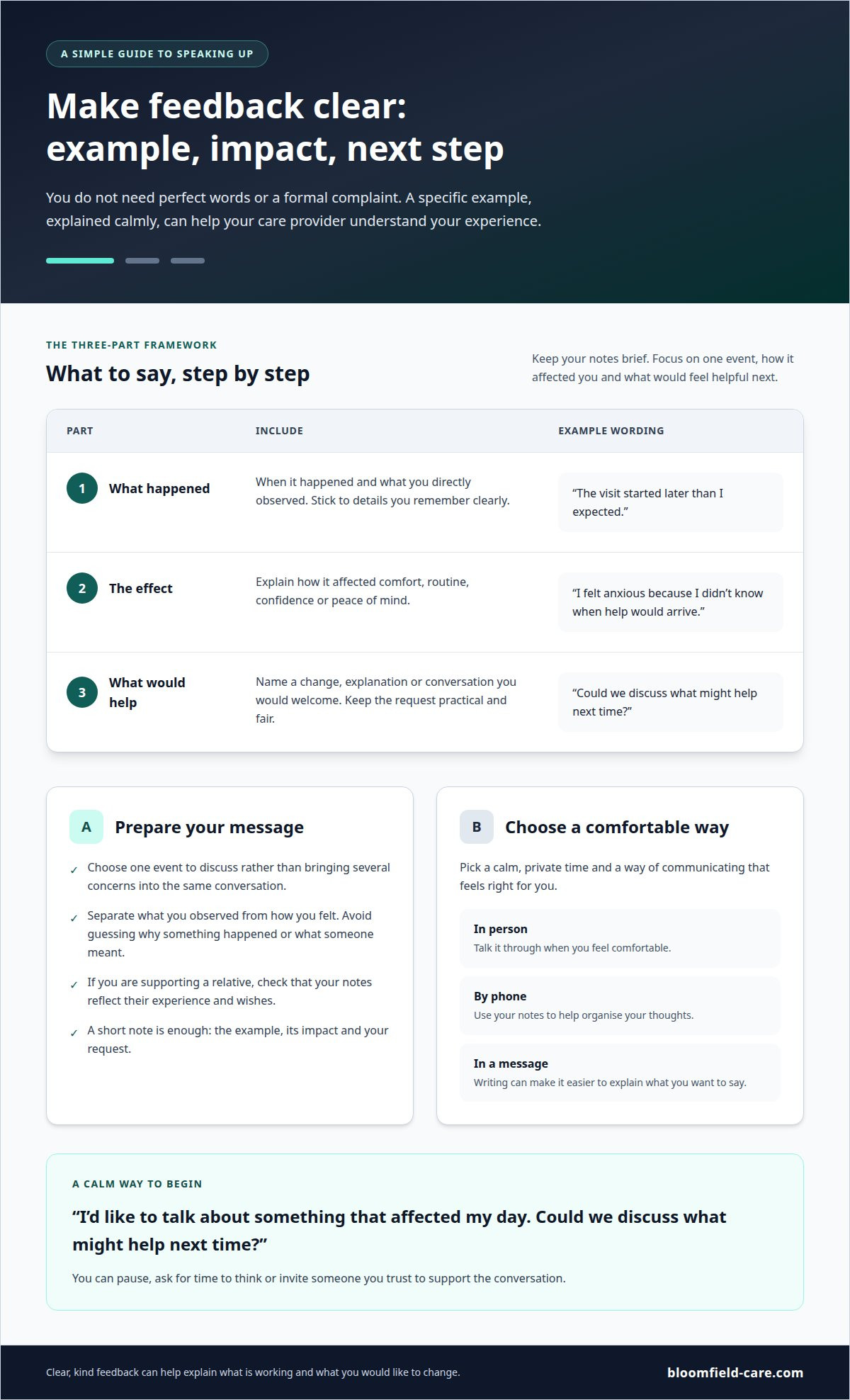
Useful feedback is a clear example, its impact on daily life and a practical next step. Keeping those three parts in mind can help you explain your experience without making assumptions about anyone’s intentions.
- Note what happened. Include when it happened and what you directly observed, using details you remember clearly.
- Describe the effect. Explain how it affected comfort, routine, confidence or peace of mind.
- Say what would help. Name a change, explanation or conversation you would welcome.
Choose the example you want to discuss
It may help to focus on one event rather than bringing several concerns into the same conversation. Be clear about what you saw or heard, and separate that from how you felt. For example: “The instructions for my afternoon routine changed, and I wasn’t sure what to expect.” Avoid guessing why something happened or what a carer meant. A clear example is easier to discuss calmly.
Only include details the person receiving care remembers confidently. If you’re supporting a relative, check that your description reflects their experience as well as your own observations. You might note that a change left them unsettled, while making clear whether they told you this or you noticed it yourself.
Decide what you hope will happen next
Before speaking, consider what would feel useful and fair. You might want a routine explained, a practical adjustment discussed or a chance to talk through what happened. Keep your first request proportionate to the issue, and involve the person receiving care in shaping it wherever possible. Their preferences should guide what happens next.
Choose a calm, private time and a way of communicating that feels comfortable. You could speak in person or by phone, or write a message if that makes it easier to organise your thoughts. A short note is enough: record the example, its impact and your request. Bring it with you or use it to prepare, rather than feeling you need to read out a formal statement.
If you’re unsure how to begin, try: “I’d like to talk about something that affected my day. Could we discuss what might help next time?” This keeps the focus on the experience and a constructive way forward. You can pause, ask for time to think or invite someone the person trusts to support the conversation.
If you’re preparing to share feedback directly with a provider, a written outline can help you stay focused. The Care Quality Commission also has a CQC Give feedback on care service for sharing experiences with the regulator. This is separate from preparing a conversation with your provider.
How to raise a concern without making the conversation confrontational
Speaking up can feel uncomfortable when a carer is part of everyday life. You may worry that a concern will sound like criticism or make future visits feel awkward. A calm, direct conversation can keep the focus on the person’s experience and what might make their support work better. You can be courteous without playing down what matters to you.
Keep your message simple: describe what happened, explain its effect and say what would help. Use “I” or “we” statements to explain your experience, rather than guessing at someone’s intentions. For example: “I felt unsure about the plan after the routine changed. Could we talk about how to make it clearer?” If something is unclear, ask an open question such as, “Could you help me understand what happened?”
You can ask to speak with the provider’s named manager if you’d feel more comfortable discussing the issue with them. You don’t have to settle every detail in one conversation, and it’s reasonable to ask for time to consider what’s been said. Focus on explaining the concern clearly and understanding what can be discussed next.
Words that can help you start
A gentle opening can make it easier to begin without hiding the reason for the conversation. Try wording that feels natural to you, then explain the example and the effect it had. Clear, polite language helps you stay focused, even if you feel nervous.
- “I’d like to talk about how care is going and share something that’s been on my mind.”
- “When this happened, I felt unsettled. Could we discuss what might help next time?”
- “I really appreciate the companionship. I’d also like to talk about a change to the routine.”
Including appreciation doesn’t mean you need to soften or withdraw a concern. You can value a carer’s kindness and still explain that something needs attention. If the first words are difficult, say so: “I’m finding this hard to raise, but I want to explain what would make me feel more comfortable.”
When a family member is helping to speak up
If you’re speaking with or for a relative, include them in the conversation wherever possible. Ask how they want their views shared and give them space to speak, pause or choose not to discuss something. Your role can be to support their voice, not replace it.
Be clear about what you witnessed yourself and what you’re still trying to understand. For instance, you might say, “I noticed Dad seemed unsettled after the visit. I’m not sure what caused it, and I’d like to hear his view.” This separates an observation from an assumption, while keeping your relative’s dignity and preferences central.
When deciding how to give feedback to your care provider, keep these phrases nearby as prompts. Adapt them to suit your own voice and the person receiving care.
What to do after sharing feedback with a care provider
After sharing feedback, make a brief note of when you spoke, who you spoke with and what you asked to happen. Keeping a factual record can help you remember the conversation if you want to return to it later. Include any questions you still have and store your notes somewhere private.
If you’re still unsure about what was discussed, or the change you raised hasn’t been considered, you can follow up. Explain which point you’d like to revisit and what clarification would help. You don’t need to assume what the outcome will be before you ask.
When direct feedback has not answered your concern
You could return to the person you first contacted or ask to speak with the provider’s named manager. Refer to your notes and explain what remains unclear. For example: “I’m not sure we discussed the change I asked about. Could we talk it through?” This gives the provider a clear opportunity to understand what you still want to discuss.
If you have another conversation, you may wish to note what was covered. This can help you describe the situation consistently if you decide to share your experience through another route. If someone is in immediate danger, seek appropriate urgent help rather than waiting for a routine conversation.
When to share feedback with the CQC
The Care Quality Commission (CQC) offers an external route for sharing information about care. This is separate from contacting your provider to discuss a concern about your own support. You can choose to share feedback with the CQC as well as raise the matter directly with the provider.
We are regulated by the CQC. If you’re considering posting a public review, take care not to share details that could identify the person or reveal private information about their care. Consider their wishes, and keep sensitive details for a private conversation.
If you’d like to continue a conversation about care with Bloomfield Care, you can contact your local office or use the contact form.
How to give feedback to Bloomfield Care
Sharing feedback can feel personal, particularly if you’re used to seeing the same carer and want to maintain a comfortable relationship. You don’t need to wait until you have a formal complaint or find special wording before getting in touch. A kind comment, a suggestion or a concern about care is all worth sharing in your own words.
At Bloomfield Care, each area has a named manager you can reach directly, not a call centre. A dedicated contact is available every day of the year. This gives you a direct route to explain what’s on your mind, whether you’re the person receiving care or a relative supporting them.
A direct way to share what matters
You can contact your local office and ask to speak with the named manager about your feedback. Explain as much or as little as feels comfortable. You don’t have to label the conversation a complaint to raise something that matters to you, and you can ask for a conversation rather than trying to put everything into a formal message.
Bloomfield Care provides home care visits in Dorset, Hampshire, Berkshire and Oxfordshire, and live-in care across the south of England. Local offices serve Weymouth, Dorchester, Ferndown, Wimborne, Christchurch, Bournemouth, Poole, Wallingford, Henley-on-Thames, Oxford, Abingdon, Newbury and Thatcham. Wherever you receive support, you can explain what’s working well or what you’d like to discuss with your local manager.
It may help to start with the kind of feedback you’re sharing. For example, you could say, “I’d like to pass on some praise about the companionship,” or, “I have a suggestion about the way support fits into the morning routine.” If you’re concerned, you could begin, “I’d like to talk about something that didn’t feel right for me.” These simple openings make your reason for getting in touch clear without making the conversation confrontational.
What to include when you get in touch
A few details can help you explain your experience clearly. You don’t need to prepare a lengthy account. Consider mentioning:
- The type of feedback: Say whether you’re sharing praise, offering a suggestion or raising a concern.
- The experience: Describe what happened or what part of the care you want to discuss.
- Its effect: Explain how it affected the person receiving care, such as their comfort, confidence or routine.
- What would help: Say whether you’d welcome a discussion, an explanation or consideration of a change.
For instance, you might explain that a particular part of a routine felt difficult, describe how that affected the person’s day and ask to discuss what might work better. If you’re a relative, make clear which details you observed yourself and which are your loved one’s own words. Include the person receiving care in the conversation wherever possible, and let their wishes guide what you share.
Feedback doesn’t need to be perfectly organised to be useful. A few notes can help you feel prepared, but it’s also fine to explain things as they come to mind. Call your local Bloomfield Care office or use the contact form to share what matters to you.
Choose a first step that feels right
You don’t have to wait until you feel completely confident before speaking up. A small first step might be deciding what you want the provider to understand or choosing when you feel ready to talk. You remain in control of what you share and how you express it.
Whether you want to recognise thoughtful support or raise something that’s troubling you, your experience is worth hearing. Learning how to give feedback to your care provider can help you feel more prepared, but there’s no need to make the conversation perfect. Start in your own words and take it at a pace that feels manageable.
If you’d like to share feedback with Bloomfield Care, call your local office or use the contact form.
Frequently Asked Questions
Is it okay to give positive feedback to a care provider?
Yes, positive feedback is welcome and can show carers which parts of their support are meaningful to you. You might mention that a friendly chat helped someone feel less alone, or that practical help made it easier to enjoy a familiar activity. You can share praise directly with the provider, even if you have no suggestions or concerns. A short, sincere comment is enough.
Can I give feedback on behalf of a relative receiving care?
Yes, you can share an observation or help your relative explain their views. Where possible, talk with them first about what they want you to say and how they’d like to be involved. For example, you could help them write down a point or sit beside them during a conversation. Make clear which details come from your own observations and which reflect their wishes.
Should I give feedback in writing or speak to the provider?
Either can work. Choose the method that feels easiest for the person sharing the feedback and suits the subject. A written message can be useful if you want to explain a few connected points or need time to find the right words. Speaking may feel more natural for a straightforward comment. You can also write brief prompts first, then use them during a conversation.
What should I do if I feel nervous about speaking up?
Feeling nervous is understandable, and you can take a small step rather than trying to say everything at once. Write down one point you want the provider to understand, then decide whether you’d prefer to speak, send a message or have someone you trust beside you. Knowing how to give feedback to your care provider can start with simply asking for a conversation.
Can I share feedback with the CQC as well as my care provider?
Yes. You can contact your provider about a concern affecting your care and separately share your experience with the Care Quality Commission (CQC). The CQC gathers information about care services to support its monitoring, but it doesn’t resolve individual disputes between a person and a provider. If you want to discuss a personal situation or request a change, raise that directly with your provider too.
What if my relative finds it difficult to explain what they want?
Give them time and try simple, open questions, such as “What would make this visit feel more comfortable?” Offer choices if that helps, but avoid suggesting an answer or speaking for them too quickly. They may prefer to explain their view in a few words, point to a written prompt or talk when they feel settled. Reflect their words back and check you’ve understood before sharing them.
If you’d like to share feedback with Bloomfield Care, call your local office or use the contact form.