How Families and Home Carers Can Work Together in Oxford
What if bringing a home carer into your loved one’s life could support their independence rather than take it away? For families in Oxford, effective carer and family cooperation means building support around the older person’s wishes, familiar routines and choices.
It’s understandable to feel unsure where to start. Relatives may have different views about what help is needed, and small but important changes can be missed between visits. Clear communication and shared expectations help everyone stay informed while keeping your loved one at the centre of decisions.
This guide explains how to agree a respectful approach with a home carer, share useful information and raise concerns when support needs to change. A written care plan can give relatives and carers a shared reference point, while leaving room for the person’s preferences and routines to guide each visit. Bloomfield Care provides tailored home care visits in Oxford and across areas including Weymouth, Dorchester, Ferndown, Wimborne, Christchurch, Bournemouth, Poole, Wallingford, Henley-on-Thames, Abingdon, Newbury and Thatcham.
Key Takeaways
- Agree one family contact for updates, and keep essential changes clear and easy to share.
- Use your loved one’s preferences to guide conversations when relatives have different views about support.
- A simple checklist of routines, agreed tasks and useful contacts can help keep visits consistent.
- gondozó és család együttműködése Oxford works best when the older person’s wishes remain central to decisions.
- A shared care plan and tailored home care visits can support a respectful partnership.
Why family and carer cooperation matters for home care in Oxford
Inviting help into a loved one’s home can bring relief, but it may also feel like a change to a familiar, private space. Family members might have different ideas about what help is needed, while the older person may feel unsure about involving someone new in daily life. A thoughtful partnership makes room for these feelings without letting them override the person’s wishes.
Family and carer cooperation means listening to the older person, sharing relevant information and respecting their choices while agreeing how support will work in practice. It gives everyone a shared understanding of what matters, what help has been agreed and how that help fits into the person’s day. For a general overview of the role and purpose of home care, see What is Home Care?
Clear agreements can prevent avoidable confusion. If someone prefers to get dressed before breakfast, for example, sharing that routine helps family and carer respond consistently. The day may not always go to plan, but an agreed preference is a useful starting point for adapting support and discussing changes calmly.
Start with the older person’s wishes
Ask what matters most in everyday life. It might be keeping a familiar morning routine, having privacy while getting ready, choosing what to wear or receiving help only with particular tasks. Listen without rushing to solve everything. These details help make support personal rather than a set of tasks imposed on someone.
Wherever possible, include the person in conversations about care. Relatives can help make the discussion comfortable, but should avoid speaking over them or treating their preferences as less important because the family feels worried. If views differ, take time to understand the person’s choice and the practical concern behind each relative’s view.
Support should be tailored to the individual, and different services can be combined. Home care visits may include personal care, companionship, dementia care, medication support or help around the home, such as meal preparation, shopping, laundry and light housework. Agree what is relevant with the person, and respect the tasks they want to continue doing themselves.
Agree what family involvement should look like
Talk openly about the help each family member is comfortable providing. One relative might be able to visit regularly, while another may prefer to organise appointments or keep important information together. There’s no need to assume everyone can take on the same role.
It also helps to distinguish family involvement from the carer’s agreed support. Relatives may share personal knowledge, offer companionship or help communicate preferences. The carer provides the support agreed with the person. Being involved doesn’t mean taking on more than you can manage.
In Oxford, gondozó és család együttműködése Oxford can begin with three practical questions: what does the older person want help with, what would they rather do themselves, and what can relatives realistically contribute? Keeping these questions in view gives the family and carer a respectful basis for working together.
How to build clear communication between family and carer
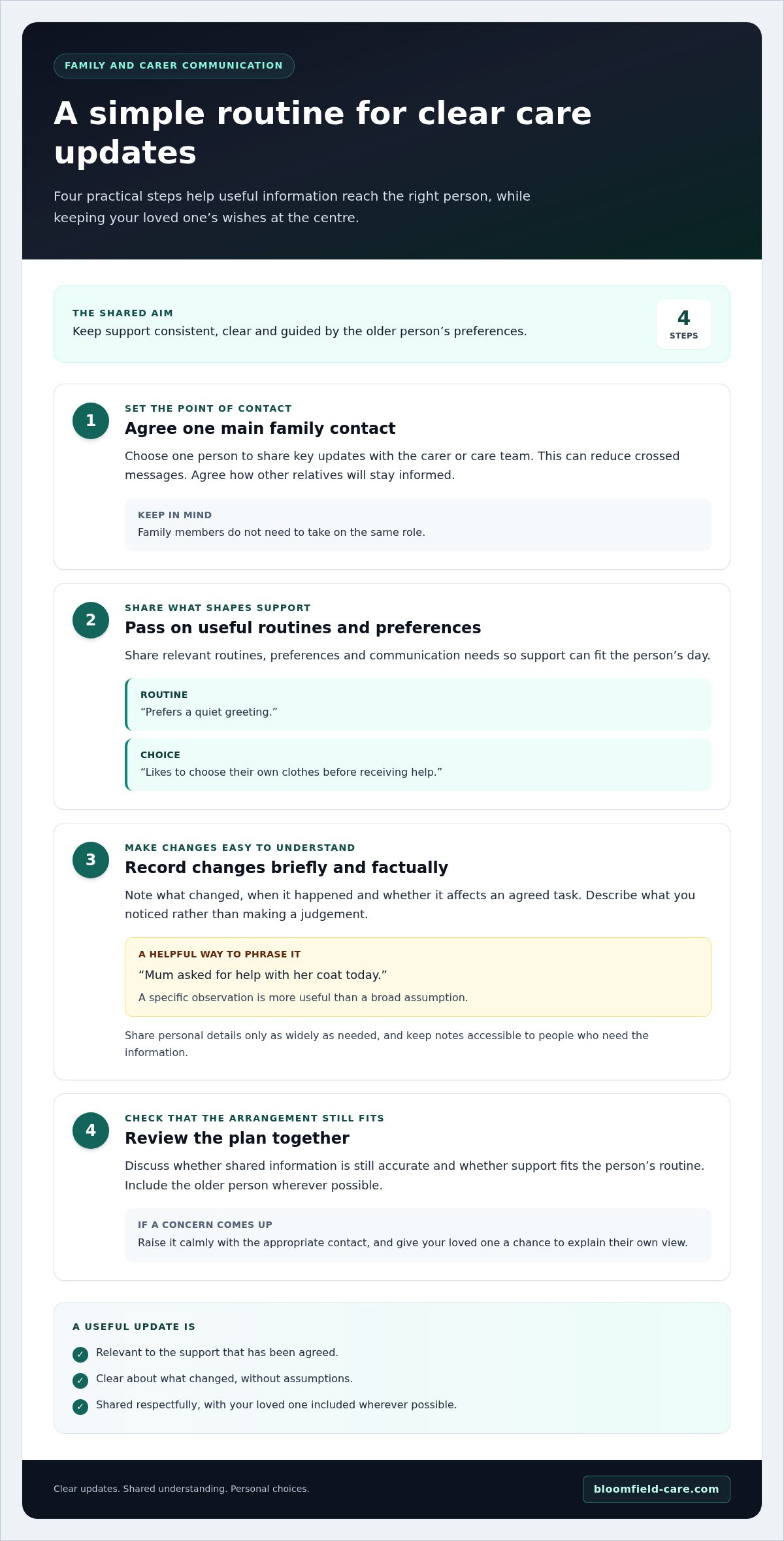
Good communication doesn’t mean sending every thought or update to everyone. It means making sure useful information reaches the right person clearly and respectfully. A simple routine helps family members and the carer understand what matters to the older person and what has changed since the last visit.
Try this practical sequence:
- Agree a main family contact. Choose someone to share key updates with the carer or care team. This can reduce crossed messages, while relatives agree how other family members will stay informed.
- Share details that shape support. Explain relevant routines, preferences and communication needs. For example, mention that your relative prefers a quiet greeting or likes to choose their own clothes before receiving help.
- Record relevant changes. Keep notes brief and factual. Say what changed, when it happened and whether it affects an agreed task. Avoid assumptions or sharing personal details more widely than necessary.
- Review the arrangement together. Discuss whether the information is still accurate and whether support fits the person’s routine. Include the older person wherever possible.
Share useful information without overwhelming anyone
Focus messages on details that help with agreed support: a change to a usual routine, a preference the person has expressed or a practical concern about a visit. Keeping essential updates distinct from general family conversation makes important information easier to spot.
If you’re concerned, describe what you noticed rather than making a judgement. “Mum asked for help with her coat today” is more useful than “Mum can’t manage any more”. Raise the matter calmly with the appropriate contact, and give the older person a chance to explain their own view.
Make everyday updates easier to follow
Agree how updates will be passed on, such as through the chosen family contact or a suitable shared note. Keep notes accessible only to people who need the information, and write them in a way that respects the person’s privacy. Oxfordshire families can also find local adult social care information through Adult Social Care in Oxfordshire.
Bloomfield Care begins each service with a free, no-obligation home visit and a written care plan agreed with the client. The visit usually takes about an hour, and the care plan is sent within two-to-three days. It gives the person, family and carer a shared reference for agreed support and preferences. Medication support means assistance with taking medication at the right time, not medical treatment.
Clear communication is central to gondozó és család együttműködése Oxford. The initial phone call usually takes 10-15 minutes. To discuss how home care can fit around your relative’s routines, talk with Bloomfield Care about home care.
How to handle different views while protecting the person’s independence
Accepting help at home doesn’t mean giving up independence. Support can help someone continue choosing how their day is organised, which tasks they do themselves and where they welcome assistance. The important distinction is between offering help and taking control.
Family members may disagree because they’re looking at the situation from different angles. One might worry that a parent is doing too much alone; another may feel extra support could unsettle familiar routines. Both concerns deserve a hearing, but the older person’s expressed wishes should remain central to decisions about daily life.
When relatives do not agree about support
Pause before proposing a change. Ask each person what they’ve noticed and what concerns them, then separate specific observations from assumptions. “Dad asked for help carrying the shopping indoors” gives the family something concrete to discuss. “Dad can’t cope on his own” may express worry, but doesn’t explain what support he wants or needs.
Bring the conversation back to the person. Ask what they think and what kind of help, if any, they’d prefer. If they want to keep doing a task, explore whether there’s a way to respect that choice while addressing the practical concern. If there’s a safety concern, describe the particular situation calmly and discuss the support already agreed. Avoid making medical judgements or treating a difference in preference as proof that someone can’t make decisions.
Compare these two responses:
- Less helpful: “We’ve decided you need help with this now.” It can make the person feel excluded and turn a family concern into a loss of choice.
- More constructive: “You’ve said you want to keep doing this. We’re concerned about this particular part. What would feel comfortable to you?” This recognises the person’s preference and makes room to discuss a practical adjustment.
Listening first doesn’t mean dismissing family concerns. It means understanding what each concern is based on before changing the support. If the discussion becomes tense, take a pause and return to it when everyone can focus on the person’s wishes and the specific issue.
Keep dignity and choice in everyday decisions
Small choices can make a difference to how support feels. Where the agreed support allows, offer options about timing, the order of tasks or how assistance is given. For example, ask whether the person would prefer help getting ready before or after breakfast, rather than assuming a routine on their behalf.
A carer’s role is to provide the agreed support respectfully, not to replace the person’s preferences with a family member’s preferred routine. Families can share useful context and concerns, while the older person stays involved in decisions wherever possible. For more context, see the related guide, home carer responsibilities in Thatcham.
For families considering gondozó és család együttműködése Oxford, a calm conversation can turn competing views into a clearer understanding of what matters to the person, what the practical concern is and whether the agreed support still fits.
Practical ways Oxford families can keep support consistent
A short, shared reference can help family members and a carer understand the arrangements without relying on memory or making assumptions. Keep it focused on what the older person wants and the support that has actually been agreed. It should be useful, not a record of every family conversation.
Create a simple shared reference
Bloomfield Care provides a written care plan agreed with the client. It sets out the person’s support in one place, giving the client, family and carer a reference for the agreed arrangements. Use this checklist to identify details that may be helpful to discuss and keep up to date:
- Preferences: Include the person’s preferred name, how they like to be approached and any relevant choices about privacy or how help is offered.
- Routines: Note details that shape the day, such as preferred mealtimes or the order in which the person likes to do everyday tasks.
- Agreed support: Summarise the tasks included in the arrangement. Don’t add duties or assumptions that haven’t been discussed and agreed.
- Useful contacts: Keep relevant contact details together, and make clear who is the appropriate point of contact for different matters.
- Sharing changes: Agree where relevant updates should be recorded and who needs to know, while respecting the person’s privacy.
Keep the reference easy to understand. If a preference changes, update the relevant detail rather than leaving older information in place. Involve the person in deciding what is recorded and shared wherever possible.
Notice when the arrangement may need a conversation
Support needs and daily preferences can change. A routine that once suited someone may no longer feel comfortable, or a task may take a different place in their day. These are reasons to talk with the relevant contact and hear the person’s view, not to diagnose a problem or assume a particular change will solve it.
Consider regularly whether visits still fit around the person’s routines, choices and agreed support. If someone now prefers a quiet start to the morning, for instance, discuss whether the current arrangement reflects that preference. Keep the conversation specific and involve the older person rather than making decisions about them in their absence.
Home care visits can be tailored to the person, and different kinds of support can be combined rather than treated as a fixed package. This person-led approach also informs bespoke domiciliary care in Weymouth, where support is shaped around individual needs and routines.
Consistent support is not about keeping everything unchanged. It’s about noticing when something no longer fits and agreeing what to do next. For families considering gondozó és család együttműködése Oxford, a shared reference and thoughtful review can help keep the person’s preferences visible as circumstances evolve. Read about tailored home care in Oxford.
How Bloomfield Care helps families and carers work together in Oxford
Home care should feel personal and respectful, not like a set routine imposed on the household. Bloomfield Care provides home care visits in Oxford and across Oxfordshire, with support tailored to the person. Visits are also provided in Weymouth, Dorchester, Ferndown, Wimborne, Christchurch, Bournemouth, Poole, Wallingford, Henley-on-Thames, Abingdon, Newbury and Thatcham. Families can discuss what help may suit their relative while keeping the older person’s preferences central to decisions.
What families can expect at the start
Choosing a carer is part of building a comfortable working relationship. Bloomfield Care uses a carer-person matching process, and clients meet their carers before care begins, usually a day or two before the start. This gives the person a chance to become familiar with who will be visiting and gives relatives a clearer sense of the people involved in their loved one’s support.
Families can share relevant context about the person’s home life and preferences while allowing them space to speak for themselves. Support is tailored and services can be combined. For example, home care visits may bring together personal care and companionship, or include help around the home alongside other agreed support. The mix depends on the person, rather than a fixed package.
Every carer carries photo ID. Carers wear smart polo shirts, not clinical tunics. These practical details help families know who is visiting and what to expect, while keeping the home environment familiar and welcoming.
Local support for an ongoing partnership
Each area has a named manager you can reach directly, not a call centre hundreds of miles away. Families have a local point of contact for conversations about their relative’s support. The first care review usually takes place within the first two weeks, then regularly thereafter. If a question arises or the family wants to discuss a change, they can raise it with the relevant manager and keep the older person involved.
Out-of-hours support is available every day of the year. This gives families a way to access support outside usual office hours, without suggesting that home care visits themselves are available at all times. Only live-in care provides round-the-clock support. Overnight care is a separate service, with a carer present through the night for peace of mind.
Working together doesn’t require families to have every detail settled before they begin. It can start with a conversation about the kind of home care visits that may help and how to keep the person’s wishes in view. From there, relatives and the care team can build a respectful relationship around the individual and discuss adjustments as circumstances change.
Talk with Bloomfield Care about support in Oxford, or call your local office.
Take the next step at your own pace
A good partnership doesn’t require every family member to have the same view straight away. It can begin with one thoughtful conversation about what your loved one wants to keep doing, where they would welcome help and what would make support feel comfortable. Let their answers guide the next step.
The principle behind gondozó és család együttműködése Oxford is simple: involve the person, keep their choices in view and make room to adjust as life changes. You don’t have to resolve every question before discussing support. Starting gently can help your family explore options without losing sight of the person behind the decisions.
Talk with Bloomfield Care about home support in Oxford, or call your local office.
Frequently Asked Questions
How can I involve an older relative in decisions about home care?
Ask your relative what they’d like help with before arranging tasks or routines on their behalf. A calm chat over tea may feel easier than a formal family meeting. Offer clear choices, such as whether they’d prefer support in the morning or later in the day, and give them time to think. If they find conversations tiring, discuss one topic at a time and check that you’ve understood their answer.
Can family members be involved in a home care plan?
Yes. Relatives can share helpful information and take part in discussions, with the older person’s wishes guiding their involvement. A family member might explain how their parent prefers to be addressed or describe a familiar routine. Be clear about what information your relative is comfortable sharing and with whom. The plan should reflect support agreed with the client, rather than tasks relatives assume should be included.
What should I do if my relative refuses help from a carer?
Try to understand what’s behind the refusal before pressing for an answer. Your relative may feel uncomfortable with a particular task, timing or change to their privacy. Ask what would feel different or more acceptable, and consider whether a smaller adjustment could help, such as changing when a visit takes place. Don’t argue in the moment. If you remain concerned, discuss the situation with the relevant care contact and your relative.
How can siblings share communication about a parent’s care?
Agree a simple way to share useful updates, such as one sibling sending a brief message after speaking with your parent. Include the date and practical point, rather than forwarding long conversations or assumptions. Gondozó és család együttműködése Oxford is easier to maintain when siblings know who is passing on relevant information and avoid sending conflicting instructions. Check with your parent about what they’re comfortable sharing with other relatives.
What if a family member and carer disagree about a routine?
Return to what the older person prefers and what has been agreed for their support. A relative may expect breakfast before getting dressed, while the person prefers to get ready first. Ask the person what suits them, then explain any practical concern calmly to the appropriate care contact. Avoid changing the arrangement through separate instructions. If needed, discuss whether the routine or agreed support should be reviewed.
Can home care visits in Oxford be tailored as someone’s needs change?
Yes. Home care visits can be tailored to the person, and different types of support can be combined. If someone’s usual routine changes, note what they now prefer and which agreed tasks are affected. For instance, they may want companionship alongside help around the home. Share the update with the relevant care contact so the arrangement can be discussed with the person and considered against their wishes.
How do we balance family support with a parent’s independence?
Offer help in a way that leaves your parent in control wherever possible. Before stepping in, ask whether they’d like assistance or would rather try the task themselves. Family support might mean arranging a food shop together, keeping them company or helping organise appointments, rather than taking over daily routines. Respecting a parent’s choices can include accepting that they may prefer to do some things differently from you.
To discuss home care support for your relative, call your local office or use the contact form.