Finding a Dementia Carer in Oxford: A Guide for Families
What if the right dementia support isn’t the most intensive option, but the one that best fits your loved one’s routines and changing needs? A dementia carer Oxford families feel comfortable welcoming should offer practical help while respecting the person’s dignity, independence and familiar surroundings. It’s understandable to feel unsure about inviting someone new into a loved one’s home.
The right level of support looks different for every family. This guide explains how home care visits, overnight care, with a carer present through the night for peace of mind, and live-in care differ. It also covers what to look for in a respectful, person-centred approach and how Bloomfield Care supports families in Oxford and across Oxfordshire.
Bloomfield Care tailors support to the person, and services can be combined. Each service begins with a free, no-obligation home visit and a written care plan agreed with the client. Every carer carries photo ID. Carers wear smart polo shirts, not clinical tunics. You’ll also learn what to expect when you first speak with the team, so you can take the next step at a pace that feels comfortable.
Key Takeaways
- Look for a dementia carer Oxford families can work with respectfully, whose approach supports familiar routines, personal preferences and independence.
- Compare home care visits, overnight care and live-in care by considering when support is needed and what would help your family feel supported.
- Make a simple note of daily routines, important preferences and tasks that have become difficult to manage.
- Bloomfield Care tailors support to the person, and different services can be combined as needs change.
- Understand what happens from the first phone call through to meeting a carer and reviewing the care plan.
When might a dementia carer in Oxford help at home?
When familiar routines start to take more effort, families may find themselves quietly filling the gaps. A relative might spend longer preparing meals, feel unsure about personal care or need more company during the day. Balancing support with work, family life and everyday responsibilities can become demanding. Exploring help at home doesn’t mean the family has failed or that the person must give up their independence.
There’s no single point when support becomes necessary. Dementia affects people differently, and a change in routine doesn’t by itself mean someone needs a carer. Instead, notice where practical help could make daily life easier for the person and their family. If you’re looking for a dementia carer Oxford residents can welcome into a loved one’s home, let the person’s wishes guide the conversation from the start.
What changes might prompt a family to explore support?
Think about which parts of the day are becoming tiring, stressful or harder to manage. Perhaps meals are being missed, getting dressed takes longer, or your loved one would appreciate conversation while family members are away. Help around the home may also ease a task that has become difficult, while leaving the person to continue with activities they enjoy and manage comfortably.
These are examples, not a checklist or a way to diagnose dementia. A kind first step is to talk together at a calm moment. Ask what the person finds difficult, what they’d like help with and which routines matter most. Listen without rushing to take over. The Dementia overview offers general background, but decisions about support at home should reflect the individual, not a label alone.
What should dementia support at home feel like?
Support should feel like a respectful addition to everyday life, not a takeover. A carer can follow familiar habits, offer help with a task rather than automatically doing it, and communicate patiently. Small details matter: preferred mealtimes, how someone likes to be addressed, or the order they follow when getting ready. Familiar surroundings can remain part of the person’s comfort and sense of self.
Person-centred dementia support at home means practical help shaped around the person’s wishes, familiar routines and independence.
Support can focus on the areas where help is wanted, such as meals, personal care or companionship. It should be discreet and friendly, with choices offered wherever possible. For families in Oxford and elsewhere in Oxfordshire, the question is not simply whether a carer is needed, but what kind of help would feel welcome and support the person’s everyday life.
Try beginning with one gentle question: “What would make this part of the day easier for you?” The answer may point to a small change, more company or practical help with a particular task. Keep checking in as needs and preferences change, and involve the person in decisions wherever possible.
How to assess a dementia carer’s approach in Oxfordshire
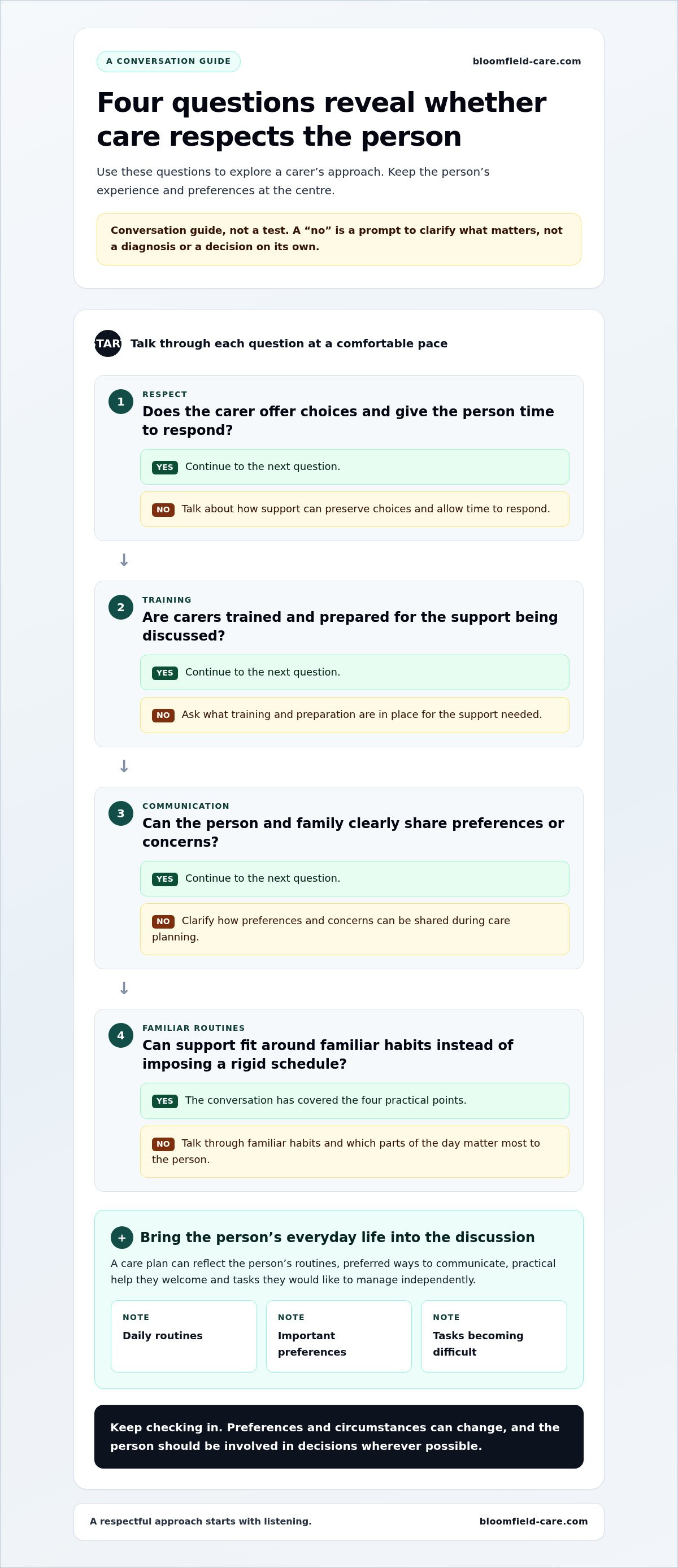
Choosing support is about more than getting a task done. The relationship should help the person feel respected and at ease at home, while giving family members confidence in the support being arranged. Consider four practical points: respect, relevant training, clear communication and how well support fits the person’s routines.
- Respect: Does the carer offer choices and give the person time to respond?
- Training: Are carers trained and prepared to provide the support being discussed?
- Communication: Can the person and family clearly share preferences or concerns?
- Routine: Can support fit around familiar habits instead of imposing a rigid schedule?
Use these points to guide a conversation, not as a test. The NHS offers guidance on dementia and care, which can help families understand the wider context. When planning support, the person’s experience and preferences should remain central.
Matching care with the person, not just a task list
A useful care plan reflects how someone likes their day to unfold. It can take account of preferred ways to communicate, familiar routines, practical help they welcome and tasks they want to manage independently. For example, a person may appreciate help preparing lunch but prefer to choose what they eat. Bloomfield Care tailors services to the person, and different types of support can be combined.
A good discussion makes room for the person’s voice as well as family observations. Preferences can be specific: a favourite time for a visit, a familiar way of doing a household task, or a preference for a quieter conversation. Sharing these details helps shape support around the individual rather than a generic list of jobs. Preferences can be revisited as circumstances or wishes change.
Reassurance, identity, and respectful visits
Inviting someone new into the home can feel like a big step. Bloomfield Care’s carers are trained and DBS-checked. Every carer carries photo ID. Carers wear smart polo shirts, not clinical tunics. Discreet, friendly visits can help the person feel that their home remains their own, with assistance offered respectfully and without taking over.
It also helps to know who to speak to about care. Each area has a named manager you can reach directly, not a call centre hundreds of miles away. Families have a direct point of contact for conversations about the person’s support.
If you’re considering a dementia carer Oxford residents can welcome into a loved one’s home, write down a few everyday preferences before discussing care. Note what the person enjoys, how they like to be approached and where they want to remain involved. Bloomfield Care uses these details to shape tailored home care visits. Families in Oxford, Abingdon, Wallingford, Henley-on-Thames, Newbury and Thatcham, as well as Weymouth, Dorchester, Ferndown, Wimborne, Christchurch, Bournemouth and Poole, can discuss home care support in their area.
Home care visits, overnight care, or live-in care in Oxford?
The right arrangement depends on when support is most useful and how the person’s needs fit into their day and night. A dementia carer Oxford families are considering may provide help through planned visits, overnight care or live-in care. These options have different patterns, and the choice doesn’t have to be all or nothing. Bloomfield Care tailors services to the person, and they can be combined.
| Support option | Pattern and purpose | May suit someone who |
|---|---|---|
| Home care visits | A carer visits at agreed times to help with particular tasks or provide company. | Wants support at parts of the day while keeping much of their usual routine. |
| Overnight care | A carer present through the night for peace of mind. | Would benefit from support during the night, rather than only during daytime visits. |
| Live-in care | A carer lives in the person’s home, providing round-the-clock support. | Needs a more continuous presence while remaining in familiar surroundings. |
What home care visits can support
Visits can focus on the support that matters most, whether that’s personal care, companionship or practical help around the home. Help around the home can include meal preparation, light housework, shopping and laundry. Medication support means assistance with taking medication at the right time.
Some people benefit from help with a particular part of the day, while others value company and reassurance during a visit. Support can also include dementia care and respite care. The plan can reflect the person’s preferences and the family’s concerns, rather than treating every visit as the same set of tasks. Different types of support can be combined as circumstances change.
How overnight care and live-in care differ
Overnight care focuses on the night, with a carer present through the night for peace of mind. Live-in care is a different arrangement: a carer stays in the home and provides round-the-clock support. It offers a more continuous presence, while overnight care focuses specifically on the night-time period.
Think about when difficulties arise, what support the person welcomes and how much help is needed across the day. If the main concern is a particular task, visits may be a practical starting point. If support is needed overnight or throughout the day and night, consider discussing the other arrangements. The Alzheimer's Society also provides information for people affected by dementia and their families.
There’s no need to settle on a fixed arrangement before discussing what would feel right. Bloomfield Care can talk through a tailored combination of home care services for families in Oxfordshire. To explore dementia care at home, call your local office or use the contact form.
A practical Oxfordshire checklist before arranging dementia care
Before discussing home support, gather a few notes about everyday life. You don’t need to have every answer or work out a complete care plan first. A clear picture of what’s going well, what feels difficult and what the person wants can make the conversation more focused and reassuring.
Prepare notes about routines and everyday support
Start with the usual shape of the day, then note where help might be welcome. Keep the notes practical and based on what you’ve noticed, rather than treating them as an assessment or diagnosis.
- Mark the parts of the day that feel hardest. Is support most useful in the morning, around mealtimes, later in the day or at another point? Note what happens and what would make that time easier.
- Record familiar routines. Include usual mealtimes, preferred activities, rest times and household habits the person values. Small details help support fit around their established way of life.
- List tasks where help may be useful. This could include preparing food, personal care, getting organised for the day, companionship or help around the home. Note what the person still likes to do independently, too.
- Share communication preferences. Write down how the person likes to be spoken to, whether they need extra time to respond and what helps them feel comfortable during a conversation.
- Add family concerns and questions. Include anything you’re unsure about, such as how support might fit into the household or which tasks matter most to address first.
Keep the notes simple. You might use a few words beside each part of the day or jot down examples as they arise. The purpose isn’t to judge the person or create a clinical record. It’s to help everyone explain what daily life looks like and what kind of assistance might be welcome.
Make space for the person and family in decisions
Where possible, involve the person living with dementia in the conversation. Choose a calm moment, ask what they’d like help with and listen to any concerns about having support at home. Family members can add their observations while keeping the person’s preferences and dignity in mind.
It can also help to agree what you hope support will make easier. Perhaps the aim is to ease pressure at a particular time of day, make room for enjoyable activities or help family members feel more confident that practical needs are being discussed. These hopes can guide a personalised conversation without requiring the family to decide everything straight away.
Choosing a dementia carer Oxford families feel comfortable welcoming into the home begins with understanding the person, not just listing tasks. Once your notes are ready, talk with Bloomfield Care about support at home.
How Bloomfield Care arranges dementia care in Oxfordshire
Starting care can feel like a significant step, so the process gives the person and family time to talk through what would help. Bloomfield Care provides home care visits across Oxfordshire, including Oxford. Each service begins with a free, no-obligation home visit, followed by a written care plan agreed with the client.
From the first call to the agreed care plan
The first conversation is a chance to explain what’s happening at home, ask questions and outline the support being considered. You don’t need to have every detail worked out beforehand. Notes about routines, preferences and tasks that feel difficult can help focus the conversation.
- Initial phone call: This usually takes 10-15 minutes. You can share your main concerns and discuss the next step.
- Home visit: A free, no-obligation visit usually takes about an hour. It gives the team time to understand the person’s needs and familiar routines at home.
- Written care plan: The plan is sent within two-to-three days of the visit. It sets out the support discussed and is agreed with the client.
The plan is tailored to the person, rather than being a fixed package. Home care services can be combined to reflect the person’s preferences and practical needs. Families can talk about what matters most and how support may fit into everyday life.
Meeting carers and reviewing support
Before care begins, the client meets carers a day or two before the start. This gives the person and family a chance to become familiar with the people who will be visiting and to discuss day-to-day preferences. The first care review takes place within the first two weeks, then regularly thereafter, so the plan can be discussed as needs or circumstances change.
Bloomfield Care provides out-of-hours support every day of the year. Each area has a named manager you can reach directly, not a call centre hundreds of miles away. A local point of contact gives families someone to speak with about the support being provided.
Bloomfield Care Ltd is CQC-registered and rated “Good” overall by the CQC as of 30 April 2022. The organisation also has 5-star Google reviews, 9.2/10 from 40 reviews on homecare.co.uk, and recognition as one of the Top 20 Small Home Care Groups 2025 & 2024.
If you’re considering a dementia carer Oxford families can welcome into a loved one’s home, talk through your needs with Bloomfield Care. Call your local office or use the contact form to discuss support in Oxfordshire.
Take the next step at your own pace
Deciding on support doesn’t mean every detail needs to be settled today. A useful first step is to talk together about what the person would welcome and what would make daily life easier. Their wishes can help shape a plan that respects familiar routines and leaves room for independence.
If you’re considering a dementia carer Oxford families can welcome into a loved one’s home, start with the questions that matter most to you. A calm conversation can help you explore what kind of support may fit, without rushing the decision.
Begin a conversation with Bloomfield Care about dementia support at home, and take the next step when it feels right for your family.
Frequently Asked Questions
Can a person living with dementia continue receiving support at home?
Yes, home-based support can be discussed in light of the person’s circumstances and preferences. A dementia carer Oxford families consider may help with practical needs while familiar surroundings remain part of daily life. Bloomfield Care tailors home care services to the person, and different types of support can be combined. A conversation can explore what feels helpful without assuming one arrangement will suit everyone.
Is a dementia carer the same as a medical professional?
No. Bloomfield Care’s dementia care is practical, home-based support, not medical treatment. A carer can help with daily activities and medication support, meaning assistance with taking medication at the right time. Carers don’t diagnose dementia or take the place of a GP or other health professional. If health questions arise, families can discuss them with the person’s GP or relevant healthcare team.
How much does dementia care in Oxford cost?
Costs depend on the support needed and how care is arranged, so there isn’t one set cost for every person. Bloomfield Care can discuss your family’s circumstances during a free, no-obligation home visit. After the visit, a written care plan is agreed with the client. This gives you time to talk through practical needs and the support being considered before deciding how to proceed.
Can home care support be adapted as someone’s needs change?
Yes. Bloomfield Care tailors support to the person, and different services can be combined as circumstances change. For example, a family might discuss adjustments if a familiar routine shifts or an everyday task begins to need support. Care reviews offer a chance to share these changes and talk through the plan together. Adjustments should reflect the person’s preferences and practical needs, without promising a particular outcome.
What should families tell a carer about a person’s daily routine?
Share what the person prefers, which routines feel familiar, how they like to communicate and which everyday tasks they welcome help with. You might note a preferred way to start the day, or whether they appreciate time to respond before assistance is offered. These details help keep support centred on the individual. They’re useful context for discussion, not a formal assessment or guarantee of a particular response.
What happens if a family is unsure which type of home care to discuss?
Begin by describing the practical situation, such as which parts of the day feel difficult and what support the person might welcome. Bloomfield Care starts with a free, no-obligation home visit and an agreed written care plan. This gives the person and family space to talk through their circumstances without choosing an arrangement in advance. To discuss care at home, call your local office or use the contact form.