Dementia carer qualifications, skills and training to look for
You don’t always need a formal qualification or previous experience to become a dementia carer, but good training and the right personal skills matter. Care training can provide a useful foundation for new workers, including knowledge relevant to dementia. Level 2 and Level 3 qualifications can build on that foundation and develop more specialist knowledge.
It’s understandable to want reassurance that a carer can provide safe, respectful support and respond calmly to changing needs. A qualification is one part of the picture: practical experience, patience and a person-centred approach matter too.
This guide explains what qualifications to look for, whether experience is essential, and what CQC registration does and doesn’t tell you about dementia training. You’ll also learn which everyday skills help someone with dementia feel heard, supported and more independent at home.
Key Takeaways
- See how Level 2 and Level 3 qualifications differ, and why a certificate alone doesn’t show how someone supports a person in practice.
- Understand what CQC registration tells you about a care organisation, and why ongoing training and supervision matter too.
- Learn to recognise person-centred skills that can help someone with dementia feel listened to and retain independence.
- Explore how introductory Level 1 learning can build foundations in areas such as safeguarding, health and safety, and duty of care.
- Find out how to consider experience, references, DBS checks and health assessments when assessing a carer’s suitability.
What is the difference between Level 2 and Level 3 care qualifications?
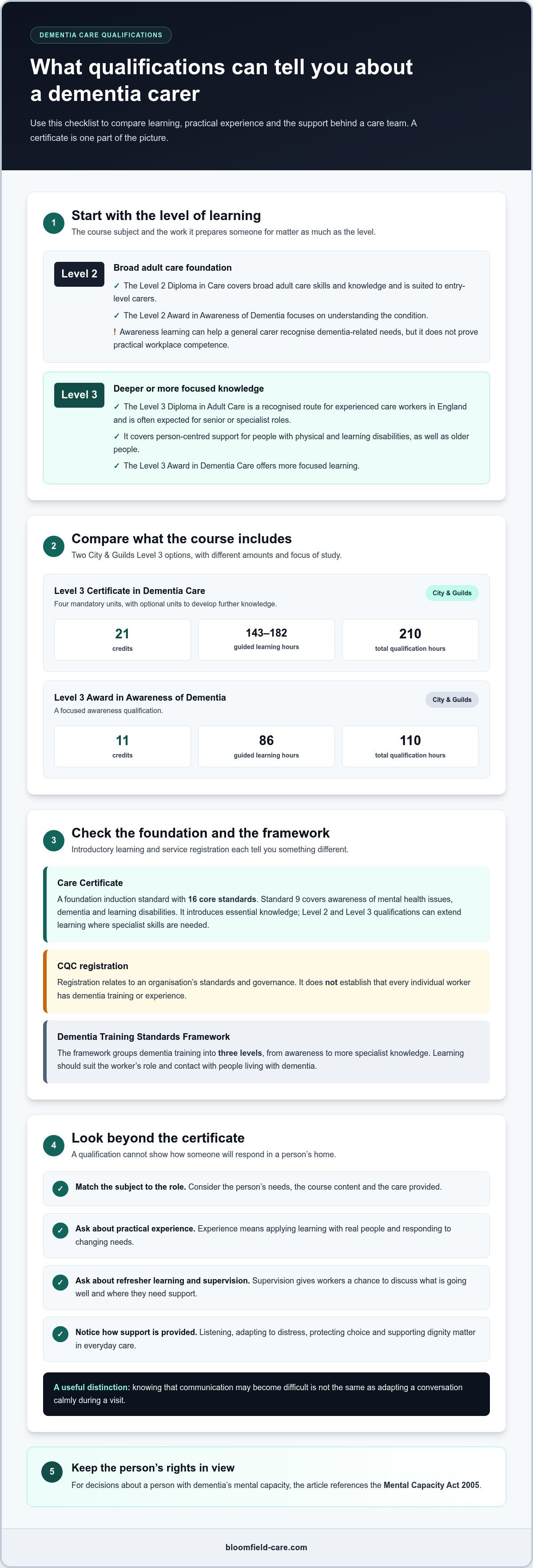
Level 2 qualifications generally build broad skills for adult care, while Level 3 study develops knowledge for more complex or specialist work. Neither level alone shows how a carer behaves in someone’s home. For dementia care, consider the subject studied, practical experience and how the person applies learning. A qualification can support safe, respectful care, but dignity also depends on listening and adapting support.
The Level 2 Diploma in Care covers broad adult care skills and knowledge, making it suited to entry-level carers. A Level 2 Award in Awareness of Dementia focuses on understanding the condition. It can help a general carer recognise dementia-related needs, but it doesn’t prove practical workplace competence. Knowing that communication may become difficult, for example, differs from adapting a conversation calmly during a visit.
Level 3 study can deepen that foundation. The Level 3 Diploma in Adult Care is a recognised route for experienced care workers in England and is often expected for senior or specialist roles. It covers person-centred support for people with physical and learning disabilities, as well as older people. The Level 3 Award in Dementia Care offers more focused learning. These courses serve different purposes, so the level alone doesn’t show which best matches a role.
Course titles and structure can make comparisons clearer. The City & Guilds Level 3 Certificate in Dementia Care carries 21 credits, with 143-182 guided learning hours and a total qualification time of 210 hours. It has four mandatory units, with optional units allowing learners to develop further knowledge. The City & Guilds Level 3 Award in Awareness of Dementia carries 11 credits, 86 guided learning hours and a total qualification time of 110 hours.
New care workers may also complete the Care Certificate, a foundation induction standard with 16 core standards. Standard 9 covers awareness of mental health issues, dementia and learning disabilities. It introduces essential knowledge; Level 2 and Level 3 qualifications can extend learning where specialist skills are needed. For decisions about a person with dementia’s mental capacity, according to UK legislation, the Mental Capacity Act 2005 is referenced.
Families asking, “What qualifications should a dementia carer have?” can compare course content with the person’s needs. Ask what the learning covers and how it relates to the care provided. Look beyond certificates, too: consider how the carer protects choice, responds to distress and supports the person’s dignity in everyday situations.
Does CQC registration guarantee all carers have dementia training?
No. CQC registration relates to an organisation’s standards and governance; it doesn’t establish every individual worker’s dementia training or experience. Consider how the care team receives training, supervision and ongoing support.
Dementia Training Framework
The Dementia Training Standards Framework groups dementia training into three levels, from awareness to more specialist knowledge. A worker’s learning should suit their role and contact with people living with dementia. A team leader may need skills beyond those used during everyday caring visits. A dementia champion can help colleagues share learning and keep the person’s needs in view.
Training needs can differ across care home, home care and NHS dementia care roles. The setting and a worker’s duties shape the relevant preparation, so a job title alone won’t show the full picture. First aid and manual handling are separate from dementia awareness. A carer’s assessment may recommend safe-lifting training when someone’s needs make it appropriate.
Experience, Refresher Training and Supervision
Experience means applying learning with real people, while supervision gives workers a chance to discuss what is going well and where they need support. Both matter: a certificate can’t show how a carer responds to an individual’s changing needs. Ask about relevant experience, recent learning and how managers discuss support for each person.
Families may want to ask how often dementia training is refreshed and whether the team discusses each person’s needs. These are useful points when reviewing a service’s approach to learning and supervision. For example, a discussion might cover how a worker can respond when someone becomes distressed or struggles to communicate.
How long dementia carer training takes and what it costs depends on the course, its level and how it is taught. A short awareness course and a broader qualification involve different amounts of learning, so there isn’t one duration or cost for every carer.
UK dementia carers can find training through recognised awarding organisations and training providers; funding may come through an employer or be paid for by the learner. Ask what qualification the course leads to and whether its content matches the work involved.
CQC registration can be a useful starting point, not a substitute for understanding individual training and supervision. For support at home, dementia care at home can be part of a family’s wider consideration of how to meet someone’s needs.
Person-centred support and wellbeing
Person-centred support starts with the individual, not a checklist of symptoms. A carer learns what matters to the person, then adapts assistance to their preferences, routines and abilities. For example, someone who values making tea can be supported to do the safe parts themselves. This approach respects dignity while balancing independence with safety.
Support can be useful before and after a dementia diagnosis. Before diagnosis, a family may notice changes in familiar tasks, conversation or daily routines. Recording examples can help explain concerns during a GP appointment. After diagnosis, sharing the person’s preferences, routines and communication needs helps carers provide familiar support. Knowing the person’s history can guide practical choices, such as keeping mealtimes calm.
Communication is central to person-centred care. If someone finds speech difficult, carers can speak a little more slowly and use simple words and sentences. Allowing time for a reply and reducing distractions, such as television noise, can help. Asking one question at a time may make a conversation easier to follow. These approaches show respect without rushing the person.
Distress or behaviour that seems difficult may signal an unmet need the person cannot express. A carer can pause to consider possible causes, such as discomfort, tiredness or a confusing environment, then respond calmly and adjust what is happening. Breaking a familiar task into smaller steps, such as choosing clothes before getting dressed, can help the person retain independence without taking over.
Family carers need support as well. In the UK, anyone over 18 who cares for someone can ask for a free carer’s assessment. It may identify help with housework or shopping, local support groups, training, or someone to take over care so the family carer can rest. Registering as a carer with a GP can also help make their caring role known during appointments.
Respite care can give family carers time to rest and recuperate. This matters when regular caring responsibilities leave little room for sleep, appointments or personal tasks. A carer’s assessment can help identify possible support, including a break from caring. Families can also discuss dementia training to help them respond to changing needs with greater confidence.
Person-centred wellbeing includes the family carer’s health, not only that of the person receiving care. Noticing when someone needs a break, asking for help with shopping or attending a local support group are practical steps. Respectful care works alongside family knowledge while keeping the person’s choices and familiar home environment central.
Introductory Level 1 qualifications
A Level 1 Health and Social Care course can introduce the foundations of caring work. It may suit someone exploring a role before choosing further study or employment. Introductory courses cover health and safety, safeguarding, duty of care, and equality, diversity and inclusion. These subjects help learners understand respectful conduct and recognise when a situation needs attention. For example, safeguarding learning introduces why concerns about a person’s wellbeing must be taken seriously.
City & Guilds says its dementia care qualifications are suitable for people aged 16 or older who are interested in caring for older people. This makes introductory learning relevant to younger people considering a future caring role, as well as adults changing direction. A Level 1 course can help build awareness of the responsibilities involved. It is a starting point, rather than evidence by itself of specialist dementia care knowledge or workplace competence.
In the UK, City and Guilds Level 1 Health and Social Care qualifications are described as roughly equivalent to GCSE grades 3-1, or grades D-G under the old system. This comparison can help families and learners understand the qualification’s level, but it doesn’t describe every course’s content. Look at the actual units studied. A learner may cover safeguarding and duty of care, while dementia-specific topics require further learning.
For someone considering care work, introductory study can make unfamiliar responsibilities easier to discuss. Health and safety may include recognising hazards in a person’s home, such as a loose rug near a walking route. Equality, diversity and inclusion encourage respectful support for people with different backgrounds and needs. Duty of care introduces the importance of acting responsibly. These foundations can help learners understand why preserving dignity matters during everyday assistance.
A Level 1 course may also help a learner decide what to study next. Someone drawn to supporting older people could explore further health and social care training, then consider dementia-focused learning suited to their role. A care provider can explain how learning relates to its work and supervision. Families can use course titles and unit details to understand what a carer has studied, while considering their practical skills and experience too.
Emotional awareness matters alongside course content. A learner who understands safeguarding, for example, may recognise that a person’s distress deserves careful attention rather than dismissal. Mental wellbeing and communication skills develop further through relevant learning and practice. Introductory study can provide useful language for discussing these needs, but good care also means listening, responding respectfully and adapting support to the person.
When reviewing Level 1 learning, focus on the course’s subjects, not just its title. Check whether it covered safeguarding, health and safety, duty of care, and equality, diversity and inclusion. Then consider how the learner applies those ideas in real situations. That gives a fuller picture of their starting knowledge and the additional preparation needed for a dementia care role.
Do dementia carers need a DBS check, references or a health assessment?
A DBS check, references and a health assessment each offer different information about a carer. None shows, by itself, how someone communicates with a person living with dementia. Checks can vary with the role and recruitment process. Consider them alongside relevant experience, training and the carer’s approach to dignity and choice.
A DBS check relates to criminal record information. It doesn’t assess dementia knowledge, caring skills or how someone responds when a person feels distressed. For example, it cannot show whether a carer gives someone time to answer or adapts their words when conversation becomes difficult. It is one part of assessing suitability, not a substitute for considering work history and conduct.
References can help explain how a carer has worked in previous roles. A useful reference may describe reliability, communication with people receiving support and how the worker follows agreed instructions. For dementia care, practical examples matter. A former manager might describe how the carer responded patiently when someone became confused during a familiar daily task. A reference should add context, not simply repeat a job title.
A health assessment may consider whether someone can carry out a particular role’s duties safely. The duties matter: helping someone walk, preparing a meal or assisting with personal care can place different demands on a worker. A carer’s assessment may also recommend training in safe lifting. Health information should be considered in relation to the role, not treated as a measure of kindness or respect.
For families, it can help to understand what each part of recruitment tells them:
- DBS check: information relevant to background screening, not proof of dementia-care ability.
- References: an account of previous work, reliability and conduct.
- Health assessment: consideration of health in relation to the role’s duties.
These checks are most useful when considered together. Someone may have a positive reference and relevant experience, for instance, but still need support with a new task. A clear induction and ongoing supervision can help workers understand an individual’s routines, communication preferences and care needs. Families can also discuss how the care team shares information when a person’s support changes.
Look for a recruitment process that considers both safety and the person receiving care. A check provides one piece of information; a conversation about experience can reveal how the worker approaches real situations. Together, these details build a fuller picture of suitability while keeping the person’s comfort, privacy and dignity at the centre.
Bloomfield Care: Live-in care
Bloomfield Care can help families consider dementia support at home when daily needs are becoming harder to manage alone. Its live-in care across the south of England offers support in familiar surroundings, while domiciliary care provides visits from local offices. The right arrangement depends on the person’s routines, preferences and support needs.
Bloomfield Care Ltd is a CQC-registered home care provider rated “Good” overall by the CQC as of 30 April 2022. If you’re weighing up live-in care, dementia care or home visits, a conversation can help you discuss what support may suit your family. Contact Bloomfield Care by calling your local office or using the contact form.
Take the next step at your own pace
Choosing support is also a chance to discuss what helps your relative feel secure, respected and at home. Note the routines they value, the communication that feels comfortable and where they would like more independence. These details can keep your relative’s wishes central in future conversations.
If you’re still weighing up what qualifications a dementia carer should have, consider how learning and experience translate into thoughtful support. You don’t need every answer before asking for advice. A conversation with Bloomfield Care can help you explore home support tailored to your family’s circumstances.
Call your local Bloomfield Care office or use the contact form to discuss support options. Taking this step can help you move forward at a pace that feels right for your family.
Frequently Asked Questions
Do you need experience to be a carer?
Not always. Some care roles welcome people who are new to the work, while others seek experience relevant to their duties. Transferable skills can help, such as dependability, careful listening and respect for personal boundaries. If you’ve supported a relative, think about what you learned, but remember that paid care involves following workplace procedures. Ask how a new worker learns tasks and receives support before taking on responsibilities.
Does a carer need to have the Care Certificate by law in England?
No, the Care Certificate isn’t a legal qualification that every carer must hold. It’s an induction standard employers may use to support learning and assess practice. When discussing a particular role, ask how the employer introduces its procedures, checks understanding and supports workers who are still developing their skills. This gives you a clearer picture of preparation than the name of a certificate alone.
What qualifications do you need to be a carer?
There’s no single qualification for every caring role. Requirements depend on the duties, the employer and the people receiving support. A role involving personal care may call for different preparation from one focused on companionship. If you’re considering what qualifications a dementia carer should have, look at the job’s responsibilities and how the worker learns to support the individual’s routines, choices and communication.
What skills do you need to be a care worker?
Care workers benefit from patience, reliability, attentive listening and clear communication. Respect for privacy matters during personal tasks, while good judgement helps a worker notice and share changes in someone’s wellbeing. For example, a carer might explain what they’re doing before entering a room or helping with a routine. These everyday actions can help a person feel involved and respected.
What qualifications are legally required to work as a dementia carer in the UK?
There isn’t one dementia-specific qualification legally required for every care worker in the UK. Employers set role requirements, which can vary with duties and responsibility. Families reviewing a service can focus on how workers are prepared for the support they provide, including how they communicate and follow an individual’s care plan. Qualifications are one part of that picture, not the whole assessment.
What qualifications do employers usually require for dementia care jobs in the UK?
Employers decide what preparation fits each vacancy, so requirements differ between jobs. A description may separate essential criteria from skills that are useful but can be developed after appointment. Look for details about duties, supervision and learning. A role involving more responsibility may ask for relevant experience, while another may focus on a candidate’s ability to learn and work respectfully.
Is a Care Certificate required for dementia carers in England, Scotland, Wales or Northern Ireland?
The Care Certificate is used as an induction standard in England, but it isn’t a universal qualification across all four UK nations. Training arrangements and employer expectations can differ by location and role. When comparing care jobs across the UK, read each vacancy’s requirements rather than assuming one certificate applies everywhere. Ask how the employer prepares workers for the specific duties they’ll carry out.
Which dementia care courses and qualifications are available in the UK, and what levels are they?
UK learners can choose general health and social care study, dementia awareness learning and more specialist dementia care courses. The right route depends on whether someone is starting care work, broadening their knowledge or preparing for greater responsibility. Compare course aims, assessment and practical content before choosing. A course covering communication and everyday support may be more relevant to a particular role than one with a similar title but a different focus.